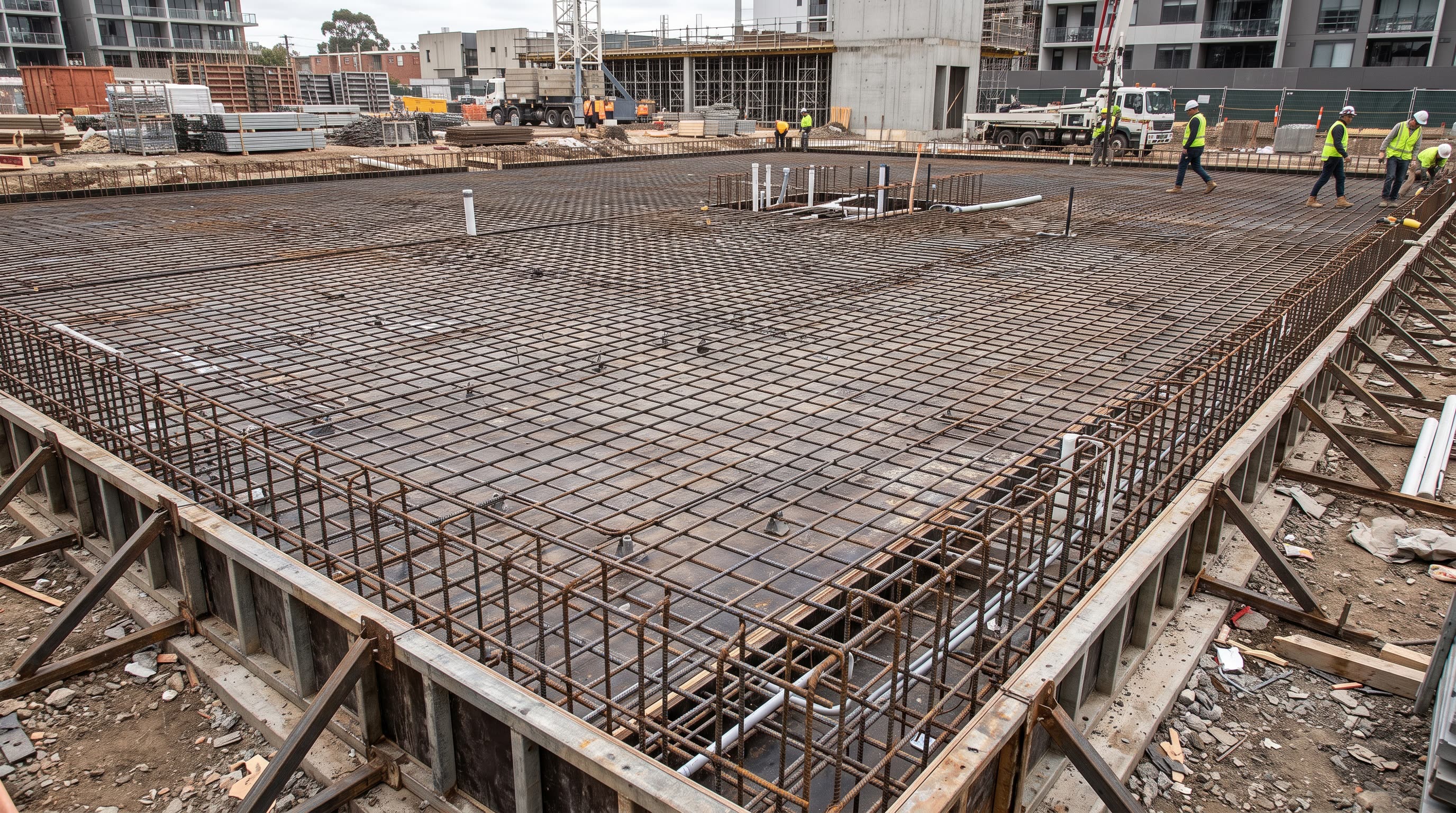
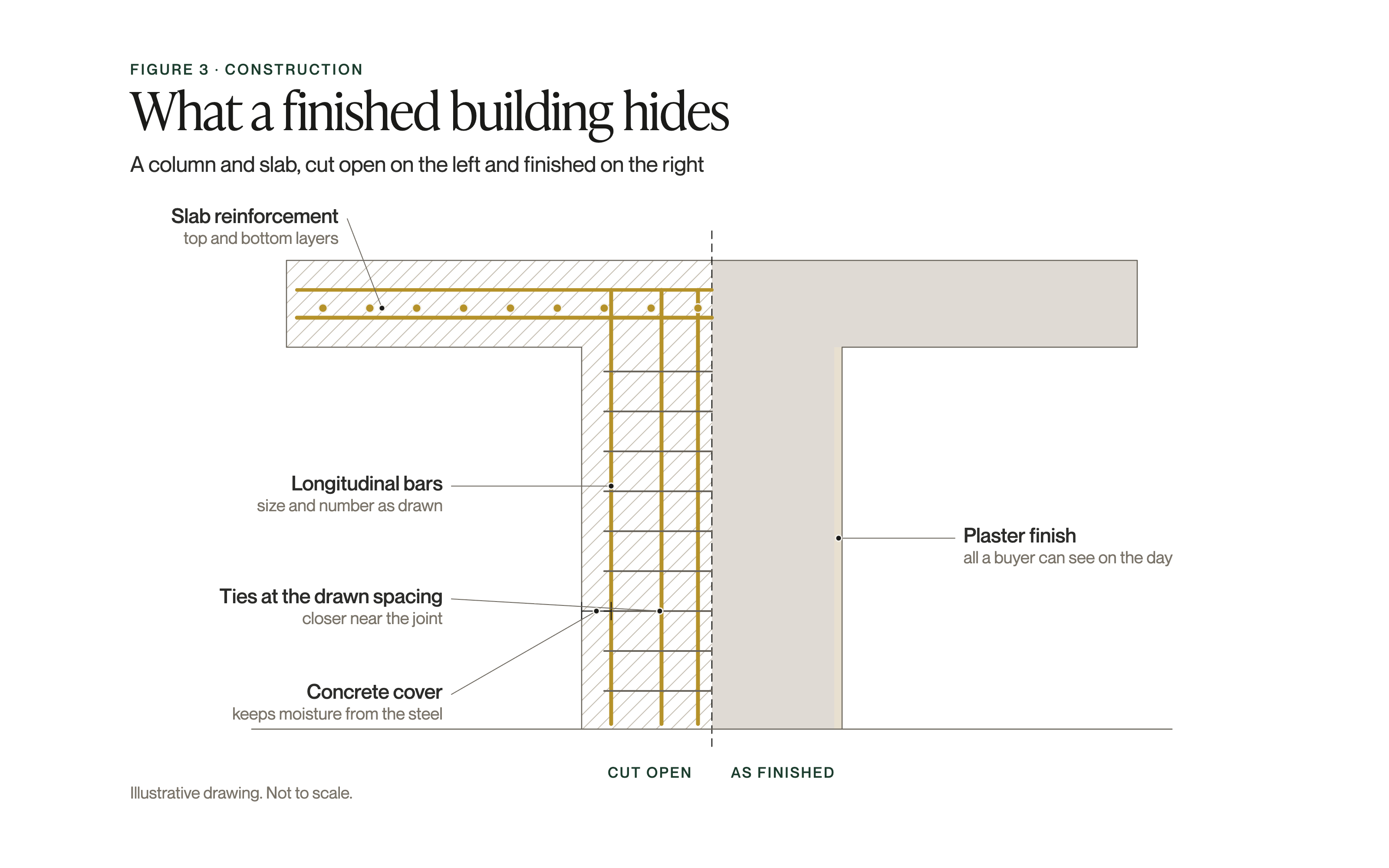
Most of what makes a building safe is invisible on the day you first see it. The steel is inside the columns. The strength of the concrete is a laboratory number. The waterproofing sits under the finish.
This is not a flaw in any one building. It is the basic economics of the product, and it creates two separate problems.
Hidden quality before purchase can drive good builders out
In 1970 George Akerlof published "The Market for 'Lemons'", using used cars as his example. When sellers know a product's quality and buyers cannot observe it, buyers will pay only for the average quality they expect. Sellers of better products cannot recover their costs at that price, and some withdraw. The average falls, and so does what buyers will pay. Economists call this adverse selection: hidden quality pushes good products out of the market.
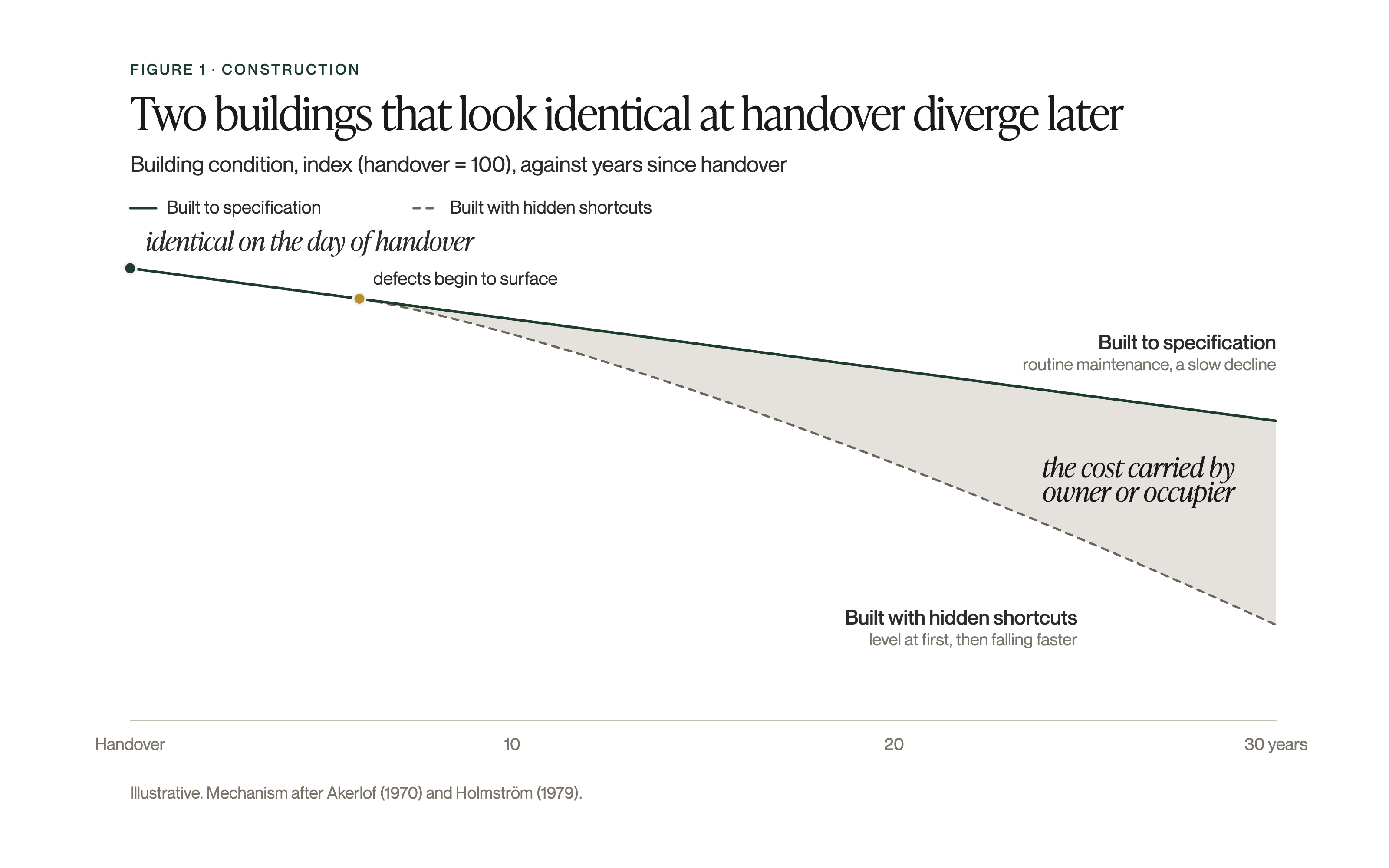
In Lahore the mechanism is easy to picture. Suppose two buildings stand on the same road and look identical at handover. One holds the steel its drawings specified. The other holds less. A buyer who cannot tell them apart will not pay the full difference. The first builder is underpaid for the steel, and the second is overpaid for its absence.
Hidden action after payment adds a second risk
Buying off-plan adds a second problem. The quality is not hidden yet. It does not exist yet. It depends on choices the builder makes after the buyer has paid.
Economists call this moral hazard: when one party's actions cannot be observed, that party has less reason to take costly care. Bengt Holmström analysed how contracts should be written under it in 1979. On a site those actions are small and daily. Is fresh concrete kept wet while it cures, which matters in a Lahore summer when it dries fast? Is the steel placed at the spacing and cover the drawing shows? Are test samples taken from each pour? Each shortcut saves something now and is buried by the next floor.
Adverse selection concerns what the builder knows. Moral hazard concerns what the builder does. An off-plan buyer faces both.
A hidden defect is a saving taken once and a cost paid every year
Expected value makes the asymmetry plain. The expected cost of a defect is its probability multiplied by the damage it causes. For a building, that cost recurs in every year it stands. A shortcut that raises the chance of seepage, cracking or early failure adds a small expected cost each year, for decades. The builder's gain is a one-off saving. The owner's loss is a yearly cost.
For a business occupier the cost runs longer than the repair bill. A failed power supply, a lift out of service or a leak above a server room costs working days. Those costs fall on the occupier, who had no say in the shortcut.
The saving is taken once, by whoever builds. The cost is paid every year, by whoever owns or occupies.
Costly signals and costly requests carry information
Michael Spence showed in 1973 how a market with hidden quality can still function. A signal carries information only if it costs more for a low-quality sender than for a high-quality one. In his model, education signals ability because it is cheaper to acquire for those who have the ability. A claim that anyone can make costs nothing, and tells the reader nothing.
Apply that test to construction. "Premium materials" in a brochure costs the same to print whether it is true or false, so it carries no information. A set of independent laboratory reports, each dated and traceable to a pour, is expensive to produce for a building that would fail them. So is a standing invitation for the buyer's own engineer to inspect at named stages.
Reputation works as a signal under one condition. A shortcut pays once; a good name pays on every future sale. The incentive to build properly holds only while future sales are worth more to the seller than today's saving. Economists call this a repeated game. A seller with no further sales faces a single round, and a single round rewards the shortcut. Ask what the seller stands to lose if a defect surfaces in year ten.
The buyer can go one step further. Michael Rothschild and Joseph Stiglitz showed in 1976, in insurance markets, that the uninformed side can screen. An insurer offers a menu of contracts so that high-risk and low-risk customers choose differently. A buyer can do the same with builders. A builder cutting corners has every reason to refuse a stage inspection. A builder who is not loses little by agreeing. The request sorts them.
Test results are samples, and the spread matters
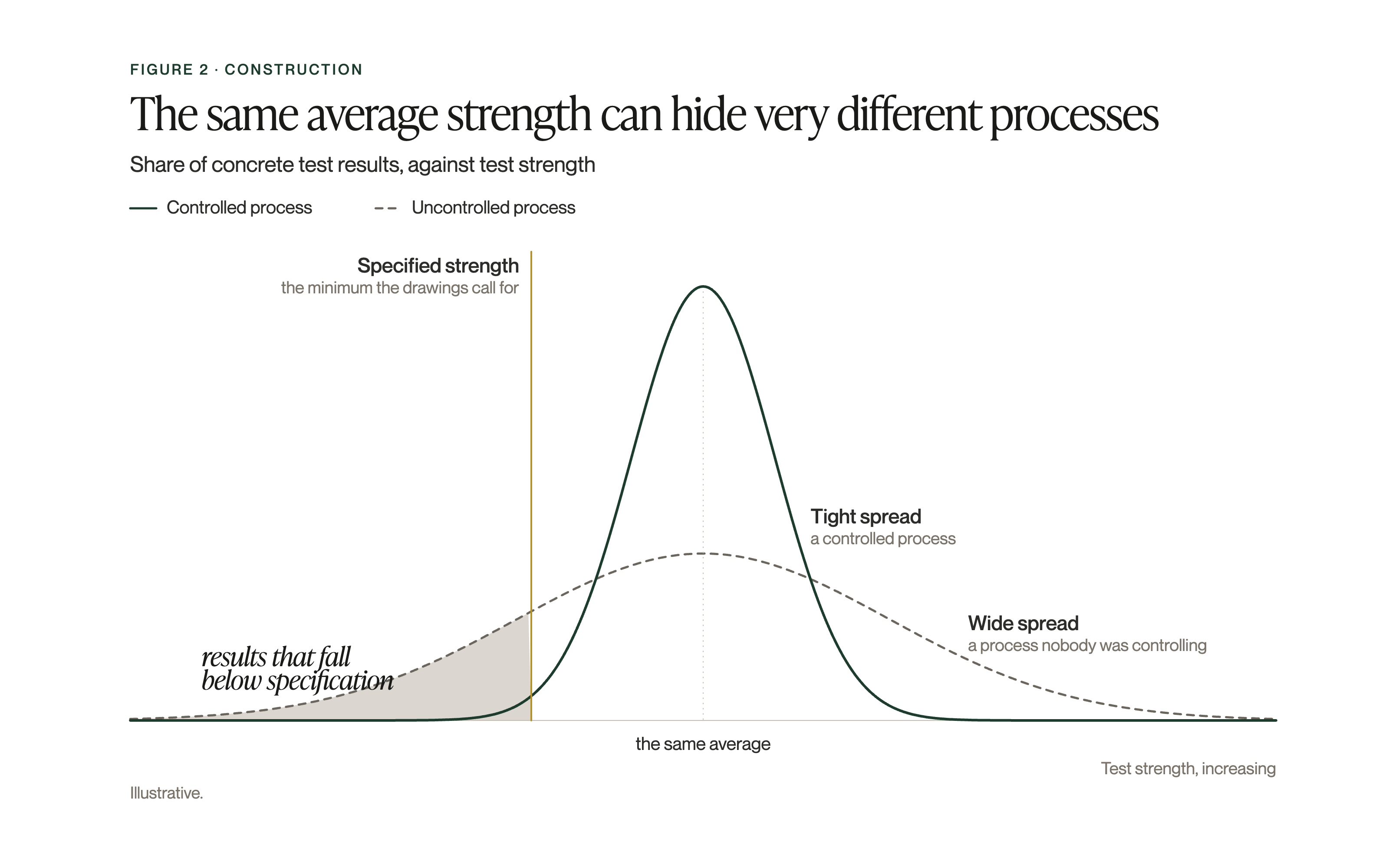
Concrete strength is conventionally tested on sample cubes or cylinders crushed in a laboratory 28 days after casting. A single good result tells you little. A test is a sample, and a sample of one has no spread. Ask for the run of results across all the pours, and read the variation as well as the average. A tight series comfortably above the specified strength points to a controlled process. A wide spread points to a process nobody was controlling, even where the average passes.
Steel, services and ground need the same evidence
Steel arrives with a mill certificate stating its grade. The certificate describes the batch the mill produced. It does not show that the batch reached this site. Ask whether bars from site deliveries were tested independently.
Building services deserve the same scrutiny, because occupiers live with them daily. A power backup system is sized against a calculated electrical load. Ask for that calculation and the capacity chosen against it, since a backup sized for today's load fails the first tenant who adds equipment. Fire safety is a design, not a fitting: escape routes, alarm coverage and who approved them. A lift is specified for an expected number of people at peak; ask what number.
Ground comes before structure. A soil investigation report tells the engineer what the foundations stand on. A building designed without one was designed on an assumption.
Pakistan issued seismic provisions for its building code in 2007, after the 2005 Kashmir earthquake. Ask which provisions the structural design follows, and who signed it.
Shahzaib Syed - Director, Strategic Development & Investor Relations at Aeyliya Builders | BSc (Hons) Mathematics and Economics from the University of Liverpool.