
Construction
Read article
The Building You Cannot See Inside
Construction quality is hidden twice: before you buy and while you wait. What can be verified, and how to read it.
M
5 min readMuhammad Shahzaib Hasnain Syed24 Oct 2026

Overseas buyers can check a location and a set of plans from abroad. The person acting for them is harder to check, and that risk can be managed.
Muhammad Shahzaib Hasnain Syed · Market · 24 Oct 2026 · 4 min read
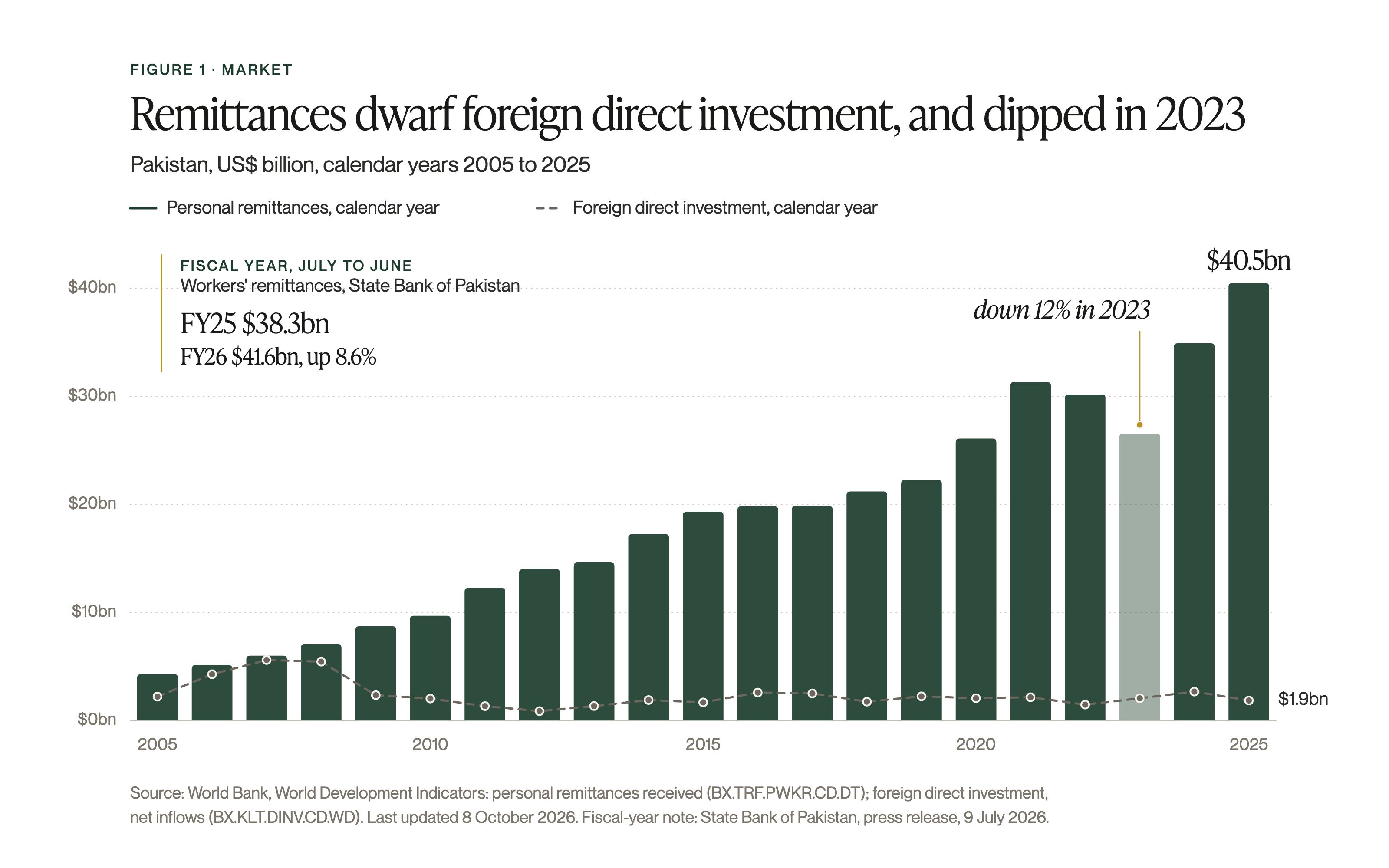
In the year to June 2026, overseas Pakistanis sent home $41.6 billion through official channels, according to the State Bank of Pakistan. That was 8.6 per cent more than the $38.3 billion of the year before.
A comparison makes the scale legible. In calendar 2025, World Bank data show personal remittances to Pakistan of $40.5 billion, against net foreign direct investment inflows of $1.85 billion: about 22 times as much.
The flow is not unconditional. On the same World Bank measure, personal remittances fell by about 12 per cent in 2023, from $30.2 billion to $26.6 billion, before recovering.
In August 2021 the State Bank launched a scheme for overseas Pakistanis to buy, build or renovate homes remotely. Sentiment is one explanation for that demand. Economics offers another.
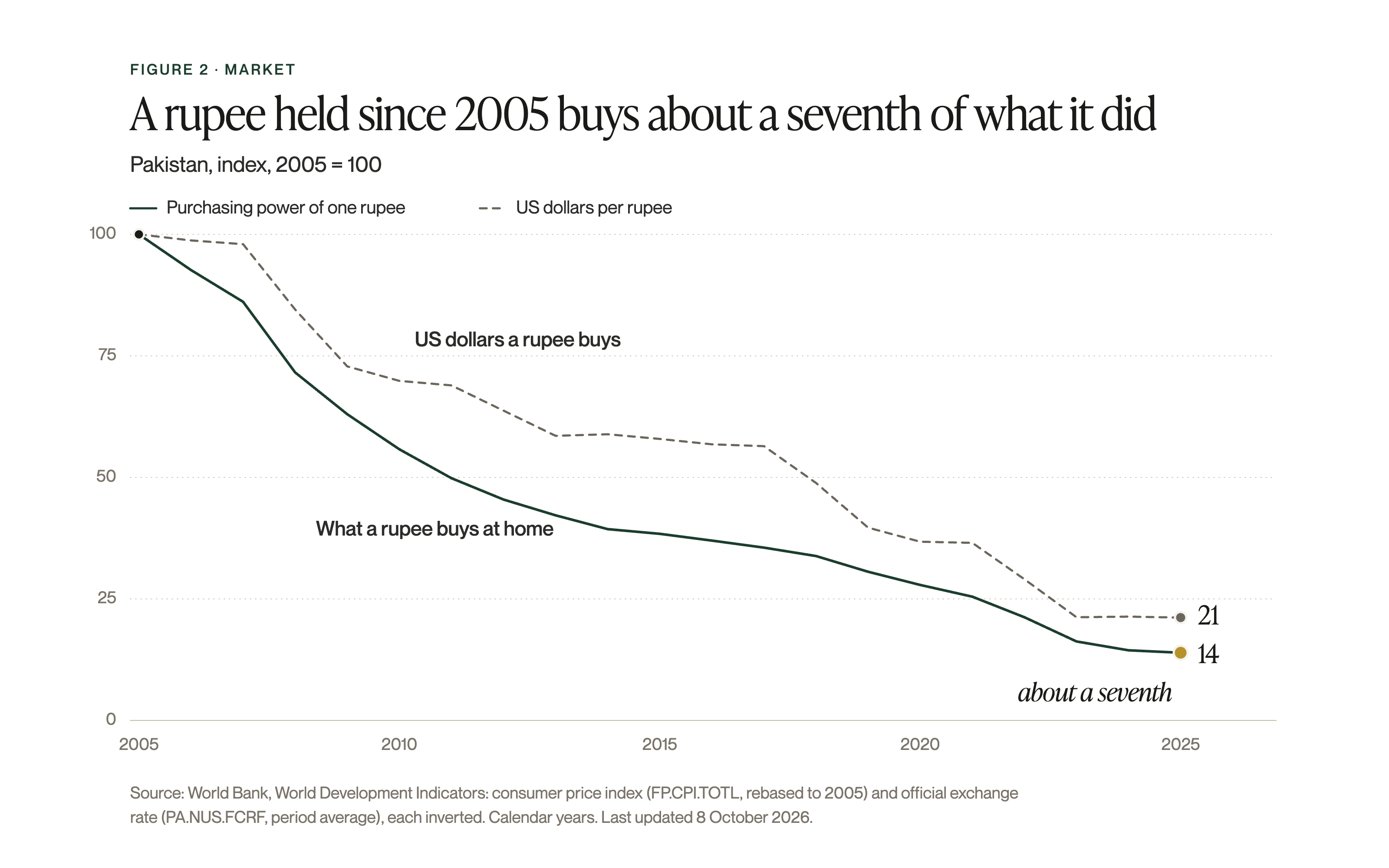
A store of value is an asset that carries purchasing power safely from one year to the next. Cash does this badly when prices rise fast. Pakistan's consumer price index rose roughly sevenfold between 2005 and 2025, so a rupee held for those twenty years kept about a seventh of what it could buy. Over the same period the rupee moved from 59.5 to 281.1 to the US dollar, on annual averages.
A saver who has watched that happen has reason to look towards real assets: gold, land, buildings. This is portfolio logic, not nostalgia. It says nothing about whether any particular property will gain value. It explains why savers want something real rather than something printed.
A location, a set of plans and the access to a site can all be checked from abroad. The person who acts for you in Lahore is harder to check.
Economists call this the principal–agent problem: one party, the principal, relies on another, the agent, whose interests differ. Michael Jensen and William Meckling gave its cost three parts in 1976: what the principal spends watching the agent, what the agent spends to reassure the principal, and the loss that remains. Distance makes each part dearer.
Consider who acts for an overseas buyer. A dealer paid by commission on completed sales has an incentive to complete a sale, not to find the right one. A relative may be entirely honest and still unable to read a title document or a structural drawing. A developer's sales team, however courteous, works for the developer.
None of them needs to be a bad actor for the problem to exist. Each is an agent whose interests differ from the buyer's.
The question is not whether the person acting for you is honest. It is whether their incentives match yours.
Jensen and Meckling's first two parts are also the two ways to narrow the gap. Monitoring is the principal paying to watch the agent. Bonding is the agent accepting a cost if they act against the principal. Each has a Lahore form. Monitoring is an engineer you hire, who reports to you and to nobody else. Bonding is a dealer who agrees to be paid only after your lawyer has cleared the title.
An overseas buyer earns in one currency and pays in another. When the payments run over several years, every instalment is a small foreign-exchange position. The economist's term is currency mismatch: income and obligations are denominated in different currencies, so a move in the exchange rate changes what each payment costs.
A buyer in Riyadh on a three-year instalment plan priced in rupees carries that position for three years. If the rupee weakens, each riyal buys more rupees and the plan costs less. If it strengthens, the plan costs more. The rupee's past path does not predict its future, and neither direction is a forecast. The point is that the exposure exists and should be measured before signing, not discovered at the fourth instalment.
A risk premium is the extra reward a buyer demands, as a lower price or better terms, for carrying a risk they cannot remove. A buyer in Manchester who cannot check what an agent in Lahore reports will rationally ask for better terms, or wait.
The premium shows up as a lower price offered, or as no purchase at all, because one side could not verify the other. The remedy is to shrink what the buyer cannot verify.
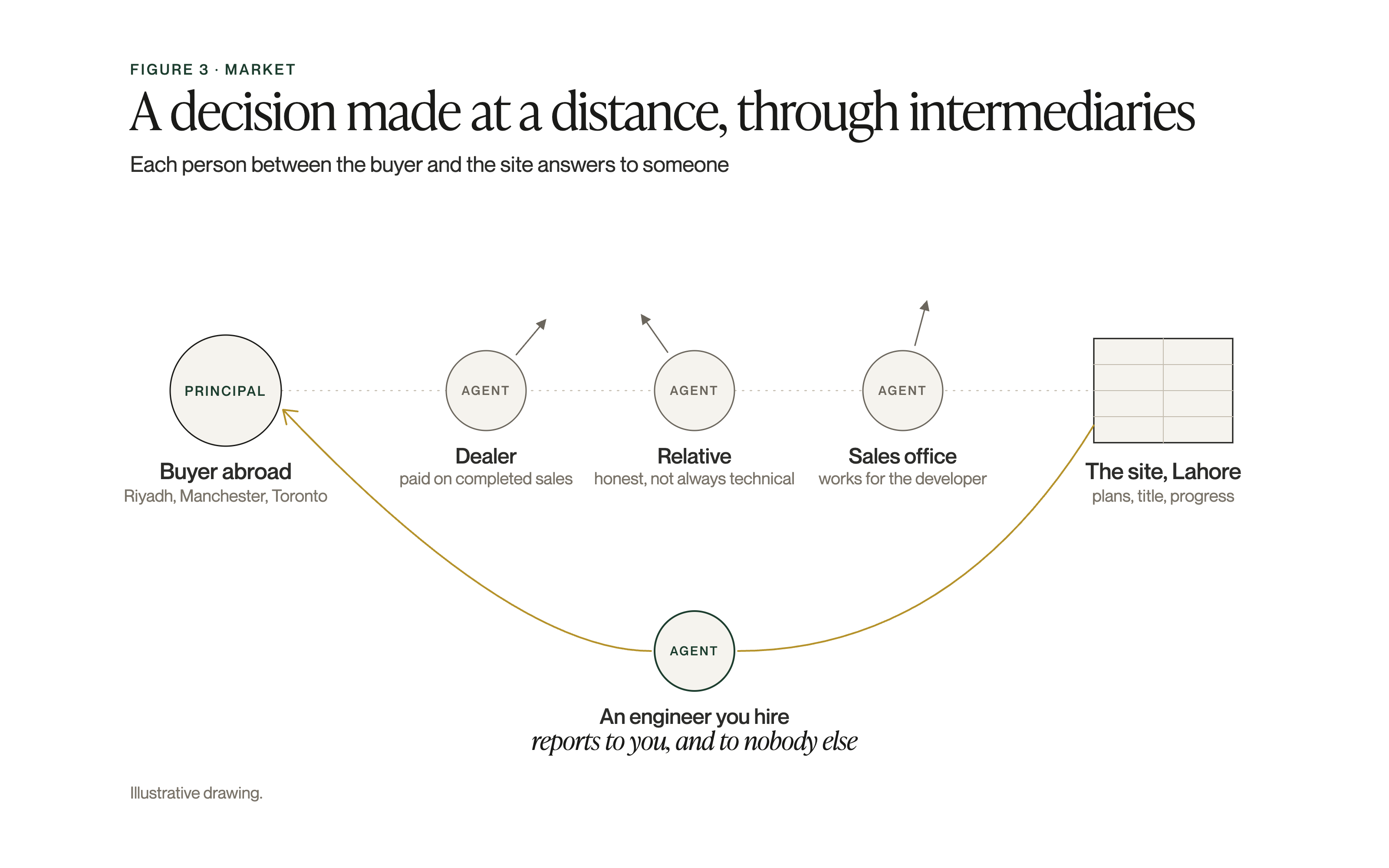
None of this requires suspicion. It requires treating an agent as an agent.
Shahzaib Syed - Director, Strategic Development & Investor Relations at Aeyliya Builders | BSc (Hons) Mathematics and Economics from the University of Liverpool.
Construction quality is hidden twice: before you buy and while you wait. What can be verified, and how to read it.

Why a developer's launch commitments weaken with time, and the four structures that keep them binding.
If something here bears on a decision you are weighing, a building, a purchase or a site, we would be glad to talk it through.