
Construction
Read article
The Building You Cannot See Inside
Construction quality is hidden twice: before you buy and while you wait. What can be verified, and how to read it.
M
5 min readMuhammad Shahzaib Hasnain Syed24 Oct 2026

Why a developer's launch commitments weaken with time, and the four structures that keep them binding.
Muhammad Shahzaib Hasnain Syed · Development · 24 Oct 2026 · 3 min read

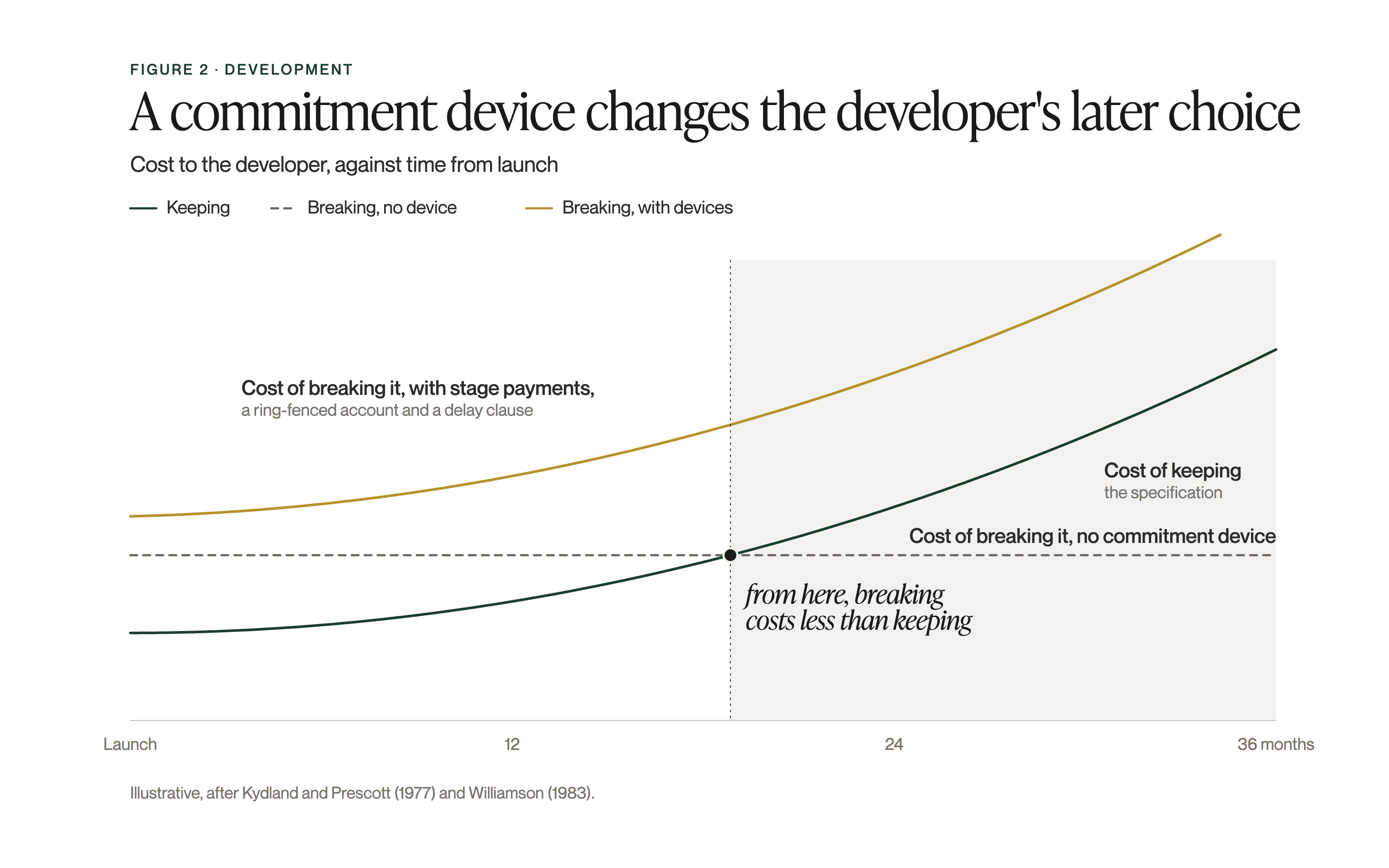
A developer's promise costs little on the day it is made. Every month after launch, it costs more to keep.
That is not a claim about character. It is a property of the timeline, and economics has a precise name for it.
Finn Kydland and Edward Prescott called it time inconsistency, in 1977. A plan is time-inconsistent when the choice that looks right today stops looking right later, once other people have acted on it. Their examples included a government that promises not to protect people who build on a flood plain, and monetary policy that promises low inflation. Once people have acted on the promise, breaking it becomes tempting.
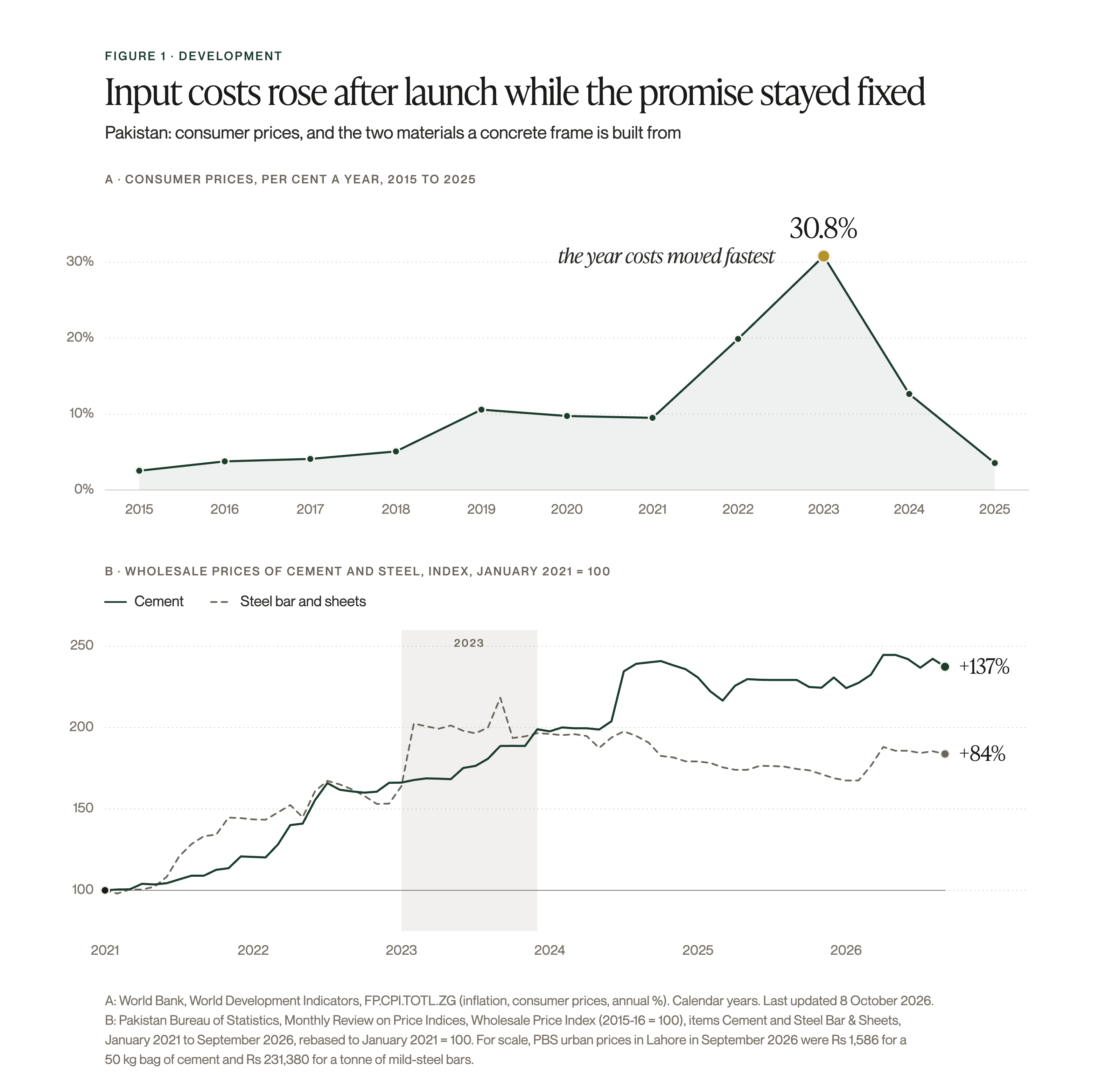
A Lahore launch runs on the same timeline. On launch day, a fixed specification and a fixed handover date cost the developer nothing and bring in bookings. Two years later the bookings are banked and prices have moved. In 2023, Pakistan's consumer price inflation was 30.8 per cent, on World Bank figures for the calendar year. Suppose the developer's costs rose with it. It must then choose between absorbing the increase and cutting the specification.
Game theory's tool here is backward induction. You solve a sequence of moves from the end, because the last mover's choice decides what every earlier promise is worth. A buyer should ask what the developer will want to do in year three, not what it says in year zero.
The answer gets worse as the buyer pays in. Benjamin Klein, Robert Crawford and Armen Alchian described the mechanism in 1978. Once one party has sunk money it cannot recover, the other can renegotiate on worse terms. This is the hold-up problem. A buyer who has paid most of the instalments on an unfinished unit cannot credibly walk away, and the developer knows it.
A buyer who discounts a brochure is not being cynical. The discount is the rational price of a promise that nothing makes binding. The useful question is which structures change that price.
A sincere promise and a binding one look identical on launch day. They separate in year three.
Kydland and Prescott's answer was not to find more honest central bankers. It was to replace discretion with rules fixed in advance. Oliver Williamson extended the logic to contracts in 1983. A commitment becomes credible when the party making it posts something it would lose by defecting. He called this a hostage.
A commitment device is any arrangement that makes breaking a promise cost more than keeping it. In property, four are worth looking for.
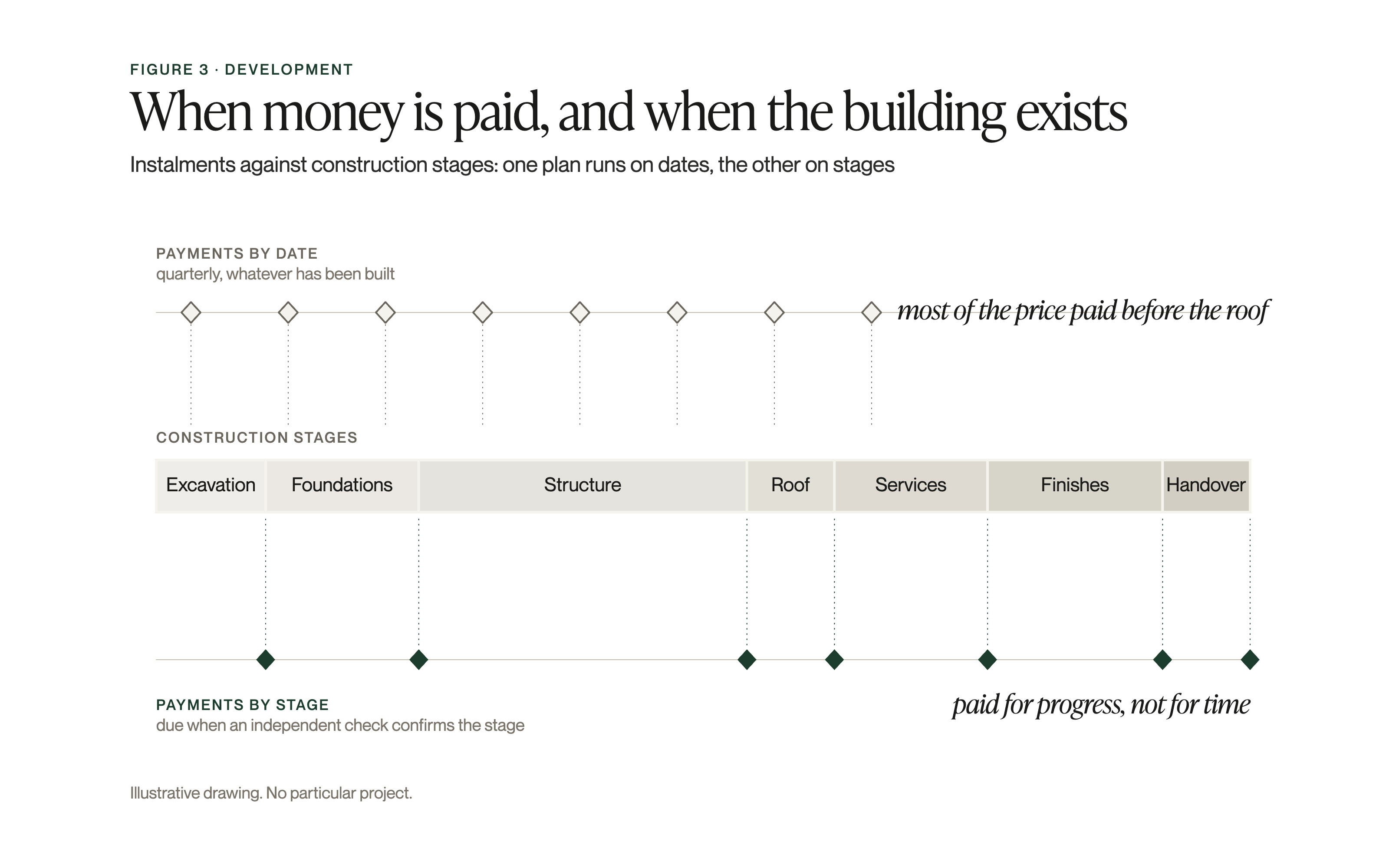
Payments tied to verifiable stages. If instalments fall due when the structure reaches a named point, the developer is paid for progress, not for the passing of time.
Buyer money held apart. If each project's receipts sit in a separate account, one building's deposits cannot cover another building's shortfall.
Specification written into the contract. A schedule of materials and grades attached to the agreement turns "high quality" into something a court can read.
A cost to the developer for delay. A clause that pays the buyer for each month of late handover is a hostage in Williamson's sense. It moves the cost of delay onto the party that controls it.
None of these depends on goodwill. Each one changes what the developer will want to do later, which is the only thing a commitment can do.
Judge the answers by the documents that support them.
Each question has a documented answer or it does not. That is the information.
Shahzaib Syed - Director, Strategic Development & Investor Relations at Aeyliya Builders | BSc (Hons) Mathematics and Economics from the University of Liverpool.
Construction quality is hidden twice: before you buy and while you wait. What can be verified, and how to read it.

Overseas buyers can check a location and a set of plans from abroad. The person acting for them is harder to check, and that risk can be managed.
If something here bears on a decision you are weighing, a building, a purchase or a site, we would be glad to talk it through.